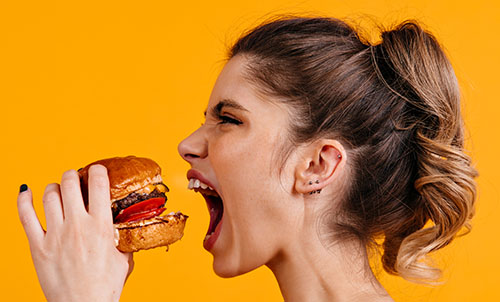
The mouth is of course where the whole story begins. Food enters our digestive tract through the mouth in a process that is known as ingestion (eating).
Once food is in the mouth the combined action of the teeth, tongue, cheeks and hard palate initiate the breakdown of food foodstuffs by chewing.
The function of chewing is not just to convert the ingested food into a size and shape that is suitable for swallowing but it is also the beginning of the process of digestion. Because this form of breakdown is entirely a consequence of the tearing and ripping of food we refer to as mechanical digestion.
In the mouth we also see the initiation of chemical digestion. The chemicals responsible for the breakdown of foodstuffs in the mouth come from saliva which is the exocrine secretion of our first set of accessory organs.
Saliva
Around about 90% of the 1500 ml of saliva secreted each day comes from the parotid, submandibular and sublingual glands (with the remainder coming from the buccal glands). Approximately 99% (by volume) of saliva is water with the remaining 1% made up by a number of proteins:
Salivary Amylase: An enzyme that initiates the breakdown of carbohydrate.
Mucin: A glycoprotein that helps lubricate the food in the mouth.
Proline-rich Proteins: A family of proteins that help with tooth enamel production and have antibacterial actions.
So by virtue of its high water content saliva helps moisten the mouth and any ingested food. The mucus that is produced from mucin helps lubricate the food (thus making it easier to swallow). The proline-rich proteins help maintain the integrity of our teeth as well as help protect us from any ingested bacteria. Finally the enzyme salivary amylase initiates the chemical digestion of carbohydrates.
Control of Saliva Secretion
Normal resting levels of saliva secretion are in the order of 0.5 ml.min-1. This basal release is sufficient to keep the mouth moist and thus assist with speech.
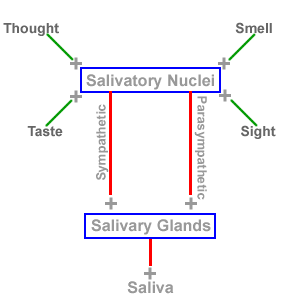
However there is a marked elevation of salivary secretion in response the thought, sight, smell or taste of food. This stimulated release is enhanced even further by the presence of food in the mouth and may reach rates in excess of 7 ml.min-1.
The elevation of salivary secretion is initiated by sensory neurones in the nose and mouth that detect the presence of food and relay this information to the salivatory nuclei in the brainstem.
These nuclei cause an increase in parasympathetic tone to the salivary glands that results in a dramatic increase in the flow of watery saliva, rich in salivary amylase and mucin.
Sympathetic tone is also increased slightly and this appears to selectively enhance the salivary amylase concentration in saliva.
This is a good example of one of the long reflexes that involve the somatosensory system (as the afferent limb) and the autonomic nervous system (as the efferent limb) that are involved in controlling digestive system function.
(Note that the dry mouth characteristic of fear or stress is caused by very high levels of sympathetic tone associated with the ‘fight or flight’ reaction that causes constriction of the blood vessels supplying the salivary glands and consequently the virtual cessation of saliva secretion. This is not part of the normal ‘physiological’ control of salivary secretion.)
The end result of all of this activity in the mouth is the formation of a lump of food that has the correct size, consistency and moisture content to be swallowed and is known as a bolus.