So far in our consideration of membrane transport we have dealt with the mechanisms by which substances move across the plasma membranes of cells. In this section we will examine one important consequence of membrane transport and that is the formation of an electrical gradient between the inside and outside of many cells. In order to understand the cause of this gradient we really only need to grasp a couple of basic concepts regarding electricity:
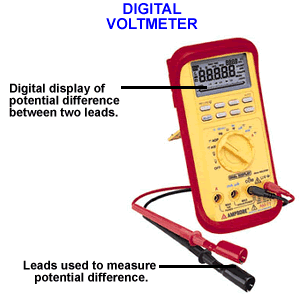
Potential Difference: Potential difference is simply defined as "the difference in charge between two points". Potential difference can be readily measured with a voltmeter (see image on right) and its unit isvolts (V) . We really don't have to concern ourselves to too much about what a voltmeter actually does but simply know that it has two leads sticking out of it and a display. The potential difference between the two leads is shown in the display in volts.For example if we take a voltmeter and connect its leads to the terminals of a typical car battery then the display will read 12 V because there is a difference in charge between one end of the battery and the other. On the other hand if we stick it on a AA battery the display will show 1.5 V because there is a smaller difference in charge between the two ends of the AA battery. In physiology the potential differences we measure are usually quite small so we tend to talk about millivolts (mV) rather than V for convenience (1 mV = 0.001 V).
Ions: An ion is any atom or molecule that has an electrical charge because it contains different numbers of protons and electrons. When there are more electrons than protons the ion is negatively charged and is called ananion . When the number of electrons is less than the number of protons then the ion is positively charged and is refered to as acation . Because of the different electric fields generated by postively and negatively charged ions (something we don't need to understand) differently charged particles are attracted to each other while similarly charged particles repel each other.The size of the charge on different ions is referred to as their valency and this is denoted in superscript following the symbol for the atom or molecule. For example chloride has a valency of -1 so would be a
monovalent anion and denoted as Cl- whereas calcium has a valency of +2 so is classified as adivalent cation and would be written as Ca2+.
If we take a voltmeter with very fine leads (known as  .The value of the membrane potential varies from cell to cell and as we will see later in semester in some cells it can also change over time.