|
The afferent division of the nervous system is involved in the relay of information from peripheral tissues to the central nervous system. Consequently this division of the nervous system is responsible for detecting stimuli that act on these tissues (from both the internal and external environment) and relaying information about the location, intensity and quality of these stimuli to higher centres. Because these stimuli usually give rise to a sensation (i.e. the conscious perception of the stimulus) this division of the nervous system is also known as the sensory division. The afferent (or sensory) division can be subdivided into two major components:
|
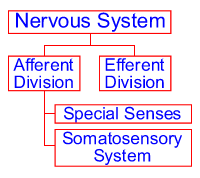 |
2. The somatosensory system is concerned with sensations that arise from tissues other than specialised sense organs. These include the skin, viscera, muscles and joints and can be conveniently subdivided into three major components:
Cutaneous Sensation - sensations that arise from the skin.
Interoreception - sensations that arise from the viscera, muscles and joints that are NOT related to movement.
Proprioception - sensations that arise from skeletal muscle and joints that ARE related to movement.
Because of time constraints, in this lesson we will concentrate on cutaneous sensation as it exhibits all the important features of the other parts of the afferent (sensory) division of the nervous system.
The basic organisation of the somatosensory system is summarised in the diagram below. Peripheral tissues are effectively connected to the cerebral cortex by a three neurone (disynaptic pathway). Activation of the primary sensory neurone (sometimes confusingly referred to as a receptor) by a stimulus produces action potentials that travel through this pathway and eventually reach the cerebral cortex where the stimulus is consciously perceived.
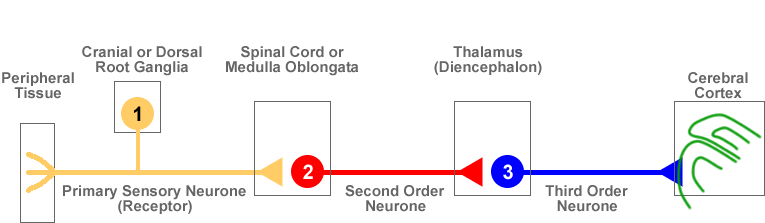
The anatomical location of each of the boxed structures is shown.