In order to understand how the increase in sarcoplasmic calcium concentration causes the contraction of a muscle fibre, we have to take a look at the molecular structure of the contractile elements (the myofibrils) themselves. Each myofibril is made up of many thousand smaller filamentous structures of two major types:
A. Thin Filaments
These filaments are in the order or 5-8 nm in diameter, around 1 micron long and are made up of three constituent proteins:
(i) Two chains of a globular protein molecules known as actin which are twisted around each other to form a double helix, much like two strands of pearls twisted together. Each actin molecule has a high affinity binding site for another protein known as myosin (see below). Actin forms the backbone of thin filaments.

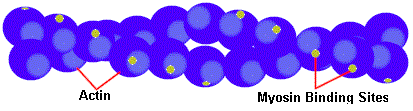
Collectively the actin double helix, the tropomyosin and the troponin complex interact to form a thin filament.(ii) Two chains of the tube-shaped protein called tropomyosin which are wrapped around the actin helix and positioned in such a way that the myosin binding sites on each molecule of actin are blocked.
(iii) The troponin complex which hold the tropomyosin threads over the myosin binding sites on the actin molecules. Troponin has the ability to do this as a consequence of its three polypeptide units. One polypeptide binds to tropomyosin, another to actin and third which binds Ca2+ and plays a critical role in triggering contraction.
B. Thick Filaments
These thicker filaments are 12-18 nm in diameter and typically 1.6 microns in length. 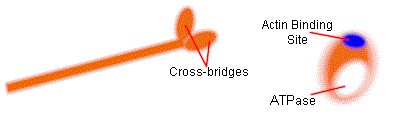 Each thick filament is made up of a large number of molecules of the protein myosin all packed together. Myosin makes up about two-thirds of all skeletal muscle protein. Each myosin filament typically is formed by about 200 myosin molecules. One end of each molecule of myosin is made up of two protein strands folded into a globular head, which looks a little like a golf club. If you can imagine the two shafts of the club wrapped around each other with the heads of the clubs sticking out of one end you will sort of get the picture.
The heads (referred to as cross-bridges) each have a binding site for actin (complementary to the myosin binding site on the actin molecules) and an ATPase. A few hundred of these myosin molecules lie parallel to each other with their shafts forming the filament itself and the radiating heads forming the cross-bridges.
So the two basic building blocks of the myofibril are these thick and thin filaments, but how do these relatively short proteins interact to form the myofibrils which may run the length of the muscle fibre? The answer to this underlies one of the most striking features of skeletal muscle fibres under the microscope and that is that they have a distinctive striped or 'striated' appearance.
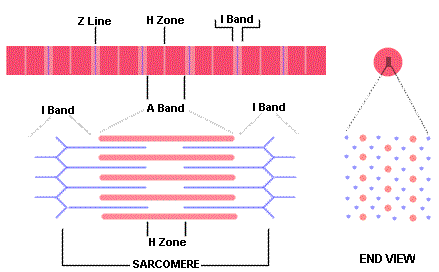
The striations observed in the whole muscle fibre represent alternating dark and light bands along the length of myofibrils. Because all the myofibrils in a muscle fibre are similarly aligned, when you look at a skeletal muscle fibre it appears striated. The dark bands are known as A bands, the light bands as I bands and the thin line which is sometimes observed down the middle of the I bands is known as the Z line.
The diagram opposite shows part of a myofibril illustrating the alternating dark and light bands and the nomenclature used to identify the different bands. Also shown is the arrangement of the thick (pink) and thin (blue) filaments that gives rise to the striations.
The alternating dark and light bands are caused by the highly ordered arrangement of the thin and thick filaments within the myofibril. The thick filaments are surrounded by six thin filaments in a hexagonal arrangement.
The dark A-bands represent the regions that contain both the very much denser thick filaments and the less dense thin filaments. The light I-bands represent the regions that contain thin filaments only.
The Z line represents the junctions between successive blocks of thin filaments, and indicates the boundaries of the basic functional unit of a myofibril which is known as a sarcomere. Essentially, whatever happens between the two Z lines is simply repeated again and again along the length of the entire myofibril. Consequently, by observing the changes that take place between two Z lines, we can see what is happening to the entire myofibril.